|
SEO updates you need to know
Sponsor: Datos
Discover how people are really searching, discovering, and engaging online
AI continues to reshape how users discover, engage, and click across search environments. But most teams are still making decisions without a clear picture of what's actually shifting.
The Datos State of Search Q1 2026 report, created in collaboration with Rand Fishkin, maps real search behaviour across millions of users in the US, EU, and UK. AI adoption, regional contrasts, e-commerce discovery, and intent signals are all explored in detail using real clickstream data.
|
Search with Candour podcast
Does Answering People Also Ask Questions Improve Rankings?
Season 4: Episode 71
Chris Green joins Search with Candour to share his study on whether answering Google’s “People Also Ask” (PAA) questions correlates with higher organic rankings.
Across the top 5 positions, pages that fully answer more PAA questions tend to rank higher.
Commercial and transactional queries show the strongest correlations; navigational and informational queries are weaker.
Beyond page 1, the correlation drops sharply and can even reverse in lower page 2 positions—likely due to small sample sizes and SERP variability.
Answering PAA questions alone isn’t enough to rank well; technical quality, external signals, and user experience still matter.
Covering a wide range of related questions can make content semantically richer, which may support ranking potential.
|
|
|
Wait! Allow me to hijack you quickly!
If you like nuanced answers, follow my Substack!
If you're subscribing to Core Updates, you're probably like me, and like your information quickly, and in bite-sized chunks. However, sometimes this can lead to misunderstandings, and some topics deserve more exploration!
That's why I've started a Substack where I take deep-dives into these topics. Last week, I wrote about:
It would be great to have you along for the ride! Anyway, onto this week's tips.
|
This week's solicited tips:
This week's solicited tips:AI is no guarantee of efficiency
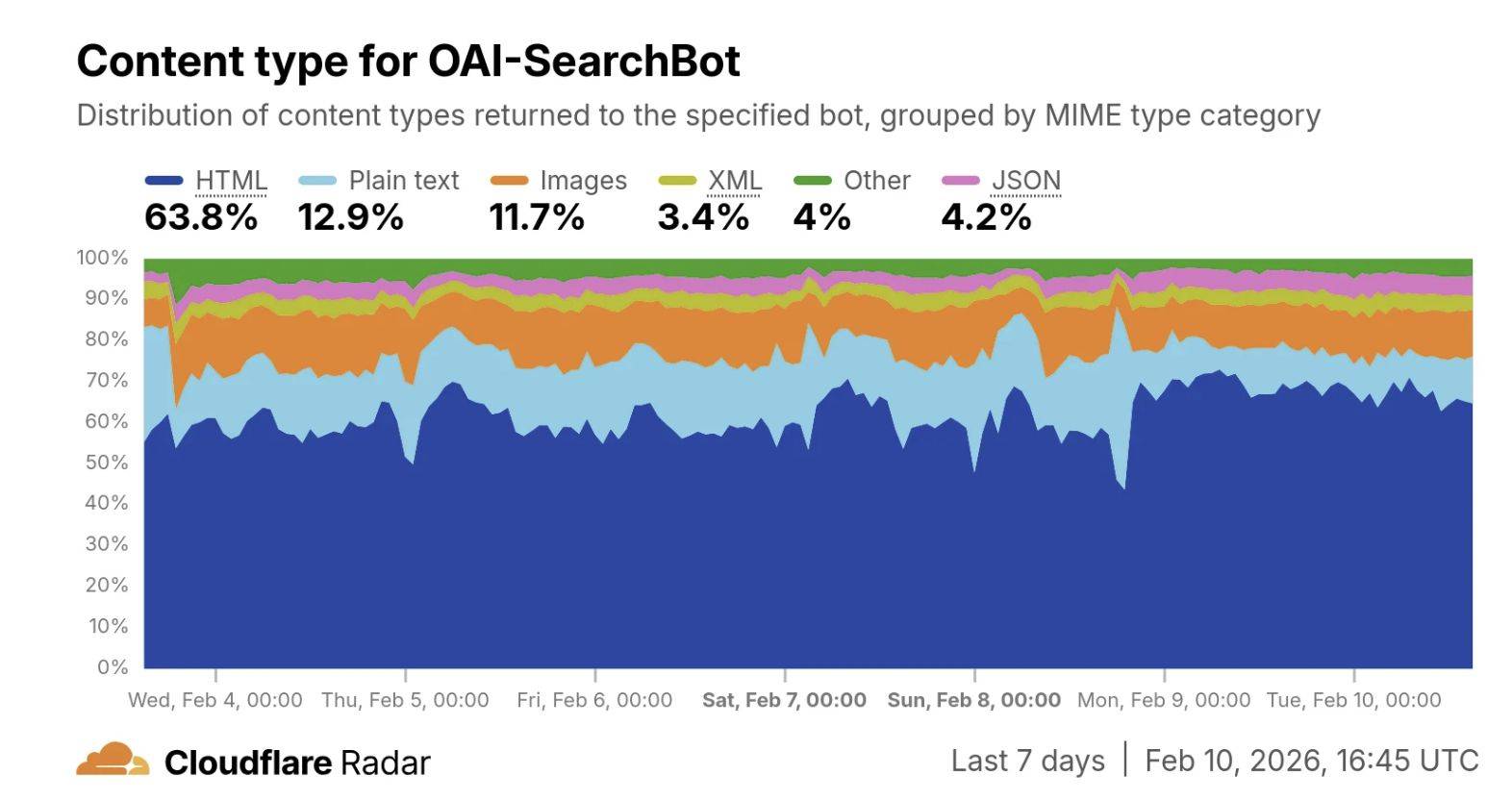
Is it worth adopting [proposed AI standard] right now? A good piece of information to use is the Cloudflare Radar.
It allows you to track the evolution of how AI bots, crawlers, and agents are consuming web content over time.
|
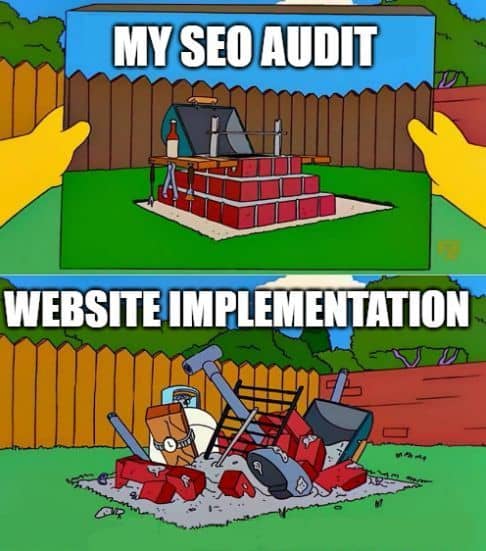
Why don't you come down here and put your implementation into it?
Your SEO audit has no impact unless it is actually implemented correctly, so let's talk about some of that process ⤵️
🏁 Validation: Is the process you go through with the client on the issues you have identified to figure out:
- "Do we even care about this?": I've completed audits where I've found issues in sections of the site, only to be told the client that part of the business wasn't a priority for them. There is no point trying to force change where it isn't wanted!
- "How difficult is this?": Usually a discussion with the devs about the realities of their current systems, priorities, tech debt, and resource. I've been surprised that relatively simply changes have sometimes proved almost impossible, and other times significant changes could be made quickly. You can't give a final prioritisation of tasks when you don't know the true cost of implementation.
✅ QA: Regardless of documentation you provide, meetings you have, emails you send, you should check the changes (ideally before they go live). I've caught hundreds of fixes that have introduced other (sometimes worse) issues, or solutions that to be very blunt, someone hasn't understood and is trying to blag. It's not a great look trying to backtrack on things on live so it's important to have a process to check. Apart from investigating individual fixes, one of Sitebulb's features is it can automatically compare to the last run audit, so you can quickly get an overview of how issues tracked there are being resolved on larger sites.
👀 Monitoring: You're here because SEO mistakes were made, and it will probably happen again (yay). Sites change, things get broken, people that haven't been upskilled will make the same mistakes, new people make new ones. You can't do your audit and then walk off into the sunset. You need a system to flag this like ContentKing when even small things like page titles have changed. Sitebulb also has a cloud version now that we use at Candour to periodically check in on sites.
Finally, for transparency, Sitebulb and ContentKing have not paid me for this post, I am a customer and pay both of them 😅
|
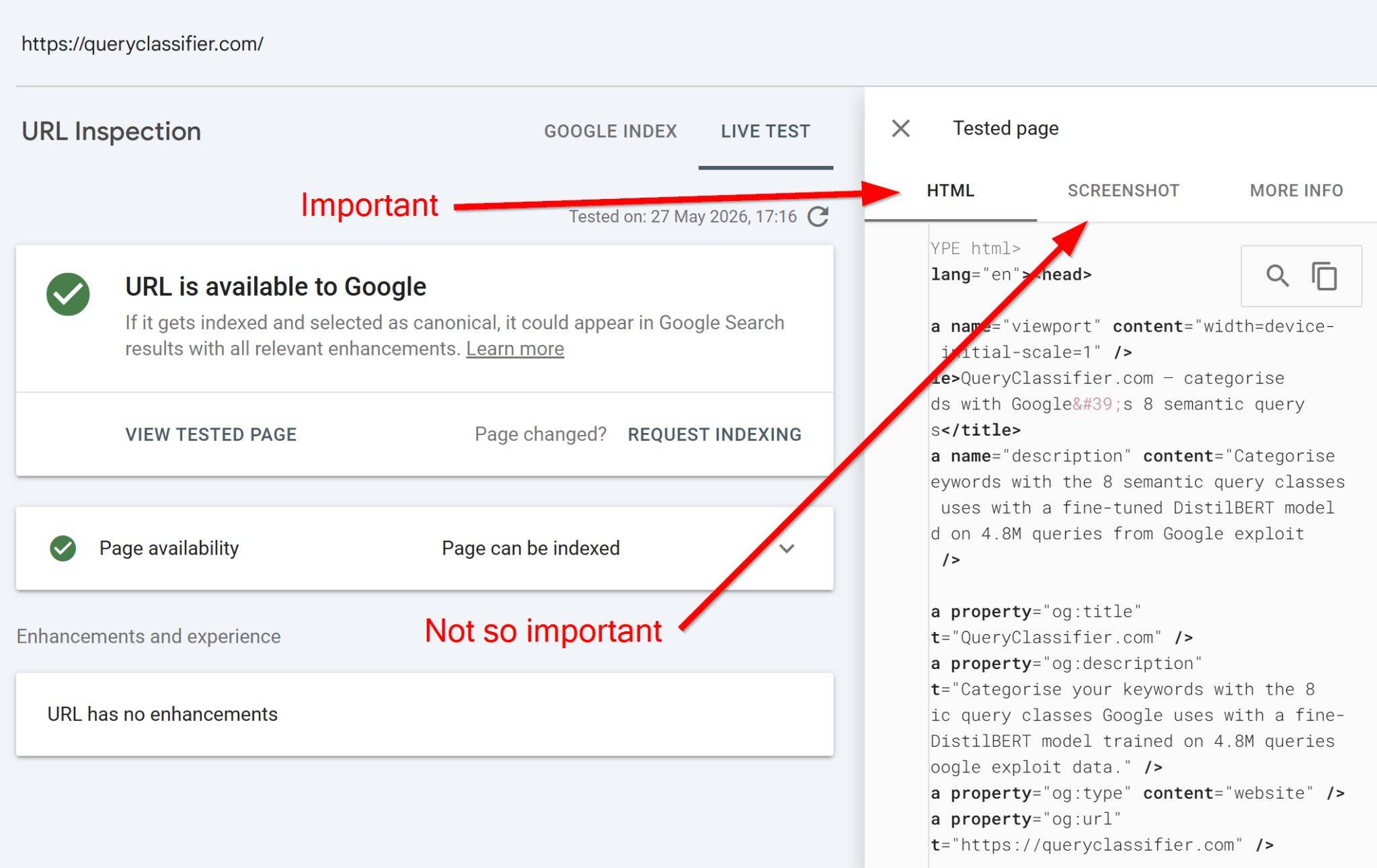
So much for my promising career in screenshots
The 'Screenshot' of live GSC inspection is actually not that important. As long as your content is viewable within 'HTML' you are almost always going to be okay.
The method Google takes to produce the screenshots in GSC is very different to their 'real' rendering capabilities. It is entirely possible for the screenshot to be completely blank, and actually, your page is rendering just fine* with no problems (I have dealt with this a few times).
This was confirmed by Martin Splitt on stage at Athens SEO (he also gave some other interesting details about batch rendering, you need to go to this conference).
*It depends
|
Do you see what comes of all this GEO, Mr Bond?
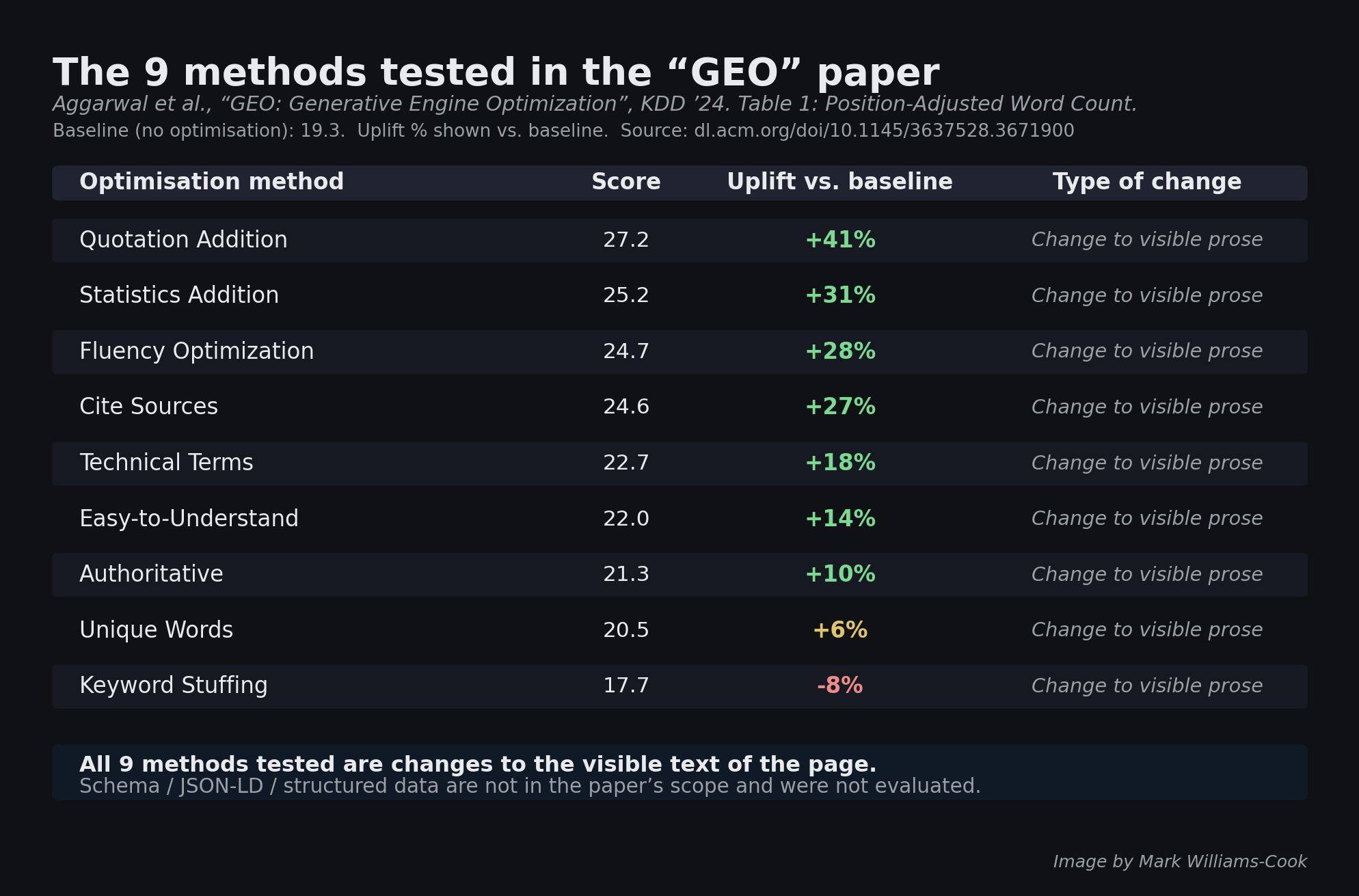
If you're interested in 'GEO', there is a Princeton peer-reviewed paper from 2024 (where the phrase "Generative Engine Optimization" actually comes from.) I read it so you don't have to. Here is the summary of findings. ⤵️
They built a benchmark of around 10,000 queries (GEO-Bench) and tested 9 different ways of "optimising" a page to get cited more often by generative search engines. Ranked by uplift over the un-optimised baseline:
✅ Quotation Addition: +41%
✅ Statistics Addition: +31%
✅ Fluency Optimization: +28%
✅ Cite Sources: +27%
✅ Technical Terms: +18%
✅ Easy-to-Understand: +14%
✅ Authoritative: +10%
➖ Unique Words: +6%
⚠️ Keyword Stuffing: -8%
A few things worth sitting with:
- Every single method they tested is a change to the visible text of the page. Quotes, stats, citations, clearer phrasing.
- Lower ranked pages benefit the most. "Cite Sources" lifted rank-5 pages by +115% on one of their subjective metrics. Useful if you are not already #1.
- Keyword stuffing actively hurt visibility, which is at least consistent with the last twenty years of classical SEO advice.
|
What was it you said? "Build the brand."
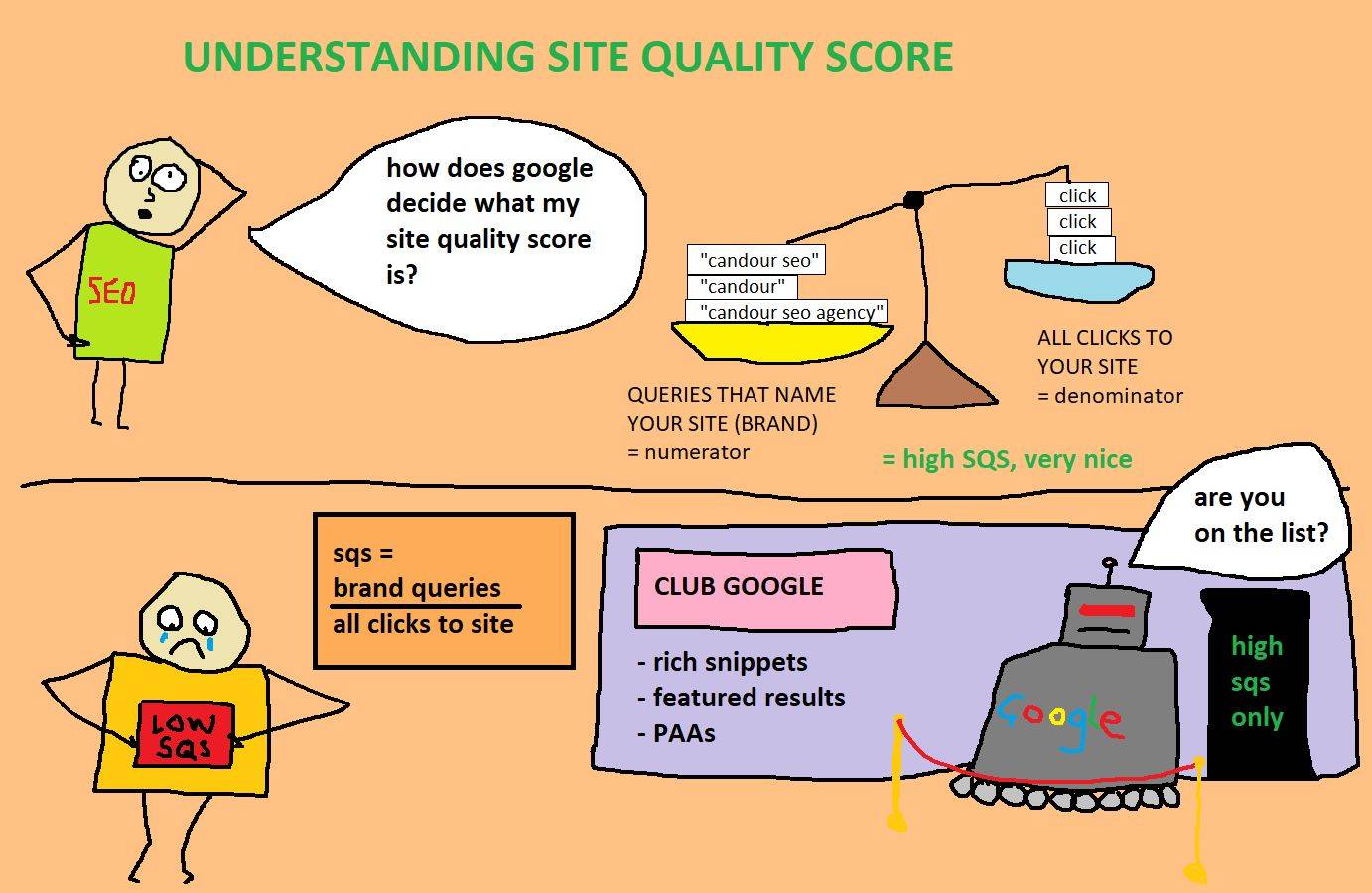
"Build your brand" can seem vague in SEO, but the Google exploit we found demonstrated one way Google does this with a metric they call site_quality_score ⤵️
Site quality score has wide-reaching implications for the visibility of your site and is used in multiple places. Google calculates you a site quality score like this:
SQS = (queries that name your site) / (all clicks to your site)
In other words: out of everyone who lands on your site from Google, what proportion specifically searched for you?
If lots of people type "candour seo" or "candour seo agency" and then click on our result, that's a strong signal that humans actively want us; our brand, not just that you happened to rank for something generic.
The patent explicitly counts brand mentions, known nicknames for your site, and navigational queries as the numerator.
We also discovered thresholds you had to hit to be eligible for features such as rich snippets, featured results, and increasingly AI Overviews.
The uncomfortable truth is this: you can win every on-page content audit, every Core Web Vital, every schema validator… and still be locked out of rich results because real humans aren't asking for your brand.
*mspaint.exe for your learning pleasure
|
Refer subscribers and earn rewards!
|
|
|