|
SEO updates you need to know
👤 |
|
Google is launching “Search profiles”: customizable pages that let eligible publishers and creators showcase their content and help audiences follow them directly in Search and Discover |
Sponsor: Kinsta
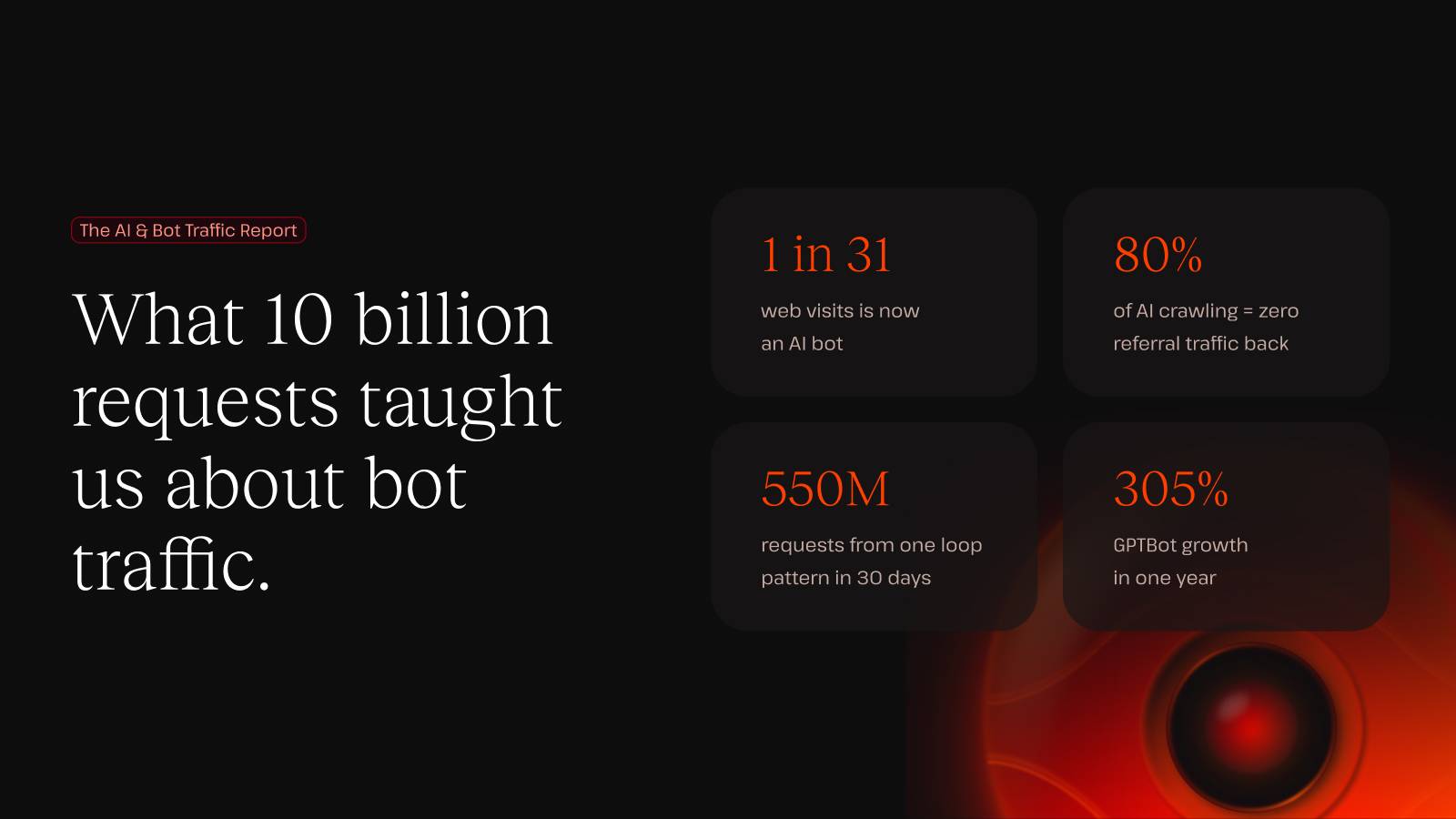
We analysed 10 billion web requests across WordPress sites.
AI bot traffic grew 300% in a single year. By late 2025, one in every 31 web requests came from an AI crawler. Scrapers, broken automation loops, and aggressive crawlers are hitting WordPress sites harder than most people realise.
Kinsta analysed more than 10 billion requests to understand what is actually happening, how modern crawlers behave, and what site owners should do about it.
|
Search with Candour podcast
The biggest SEO news from May 2026
Season 4: Episode 74
Jack Chambers-Ward hosts a May 2026 SEO news recap covering six stories including the biggest search news from Google IO.
Google’s updates to AI Mode and AI Overviews that change how links appear (in-line links, hover context, and exploring new angles), plus features around news subscriptions and surfacing expert forum advice.
|
|
|
Wait! Allow me to hijack you quickly!
If you like nuanced answers, follow my Substack!
If you're subscribing to Core Updates, you're probably like me, and like your information quickly, and in bite-sized chunks. However, sometimes this can lead to misunderstandings, and some topics deserve more exploration!
That's why I've started a Substack where I take deep-dives into these topics. Last week, I wrote about:
It would be great to have you along for the ride! Anyway, onto this week's tips.
|
This week's solicited tips:
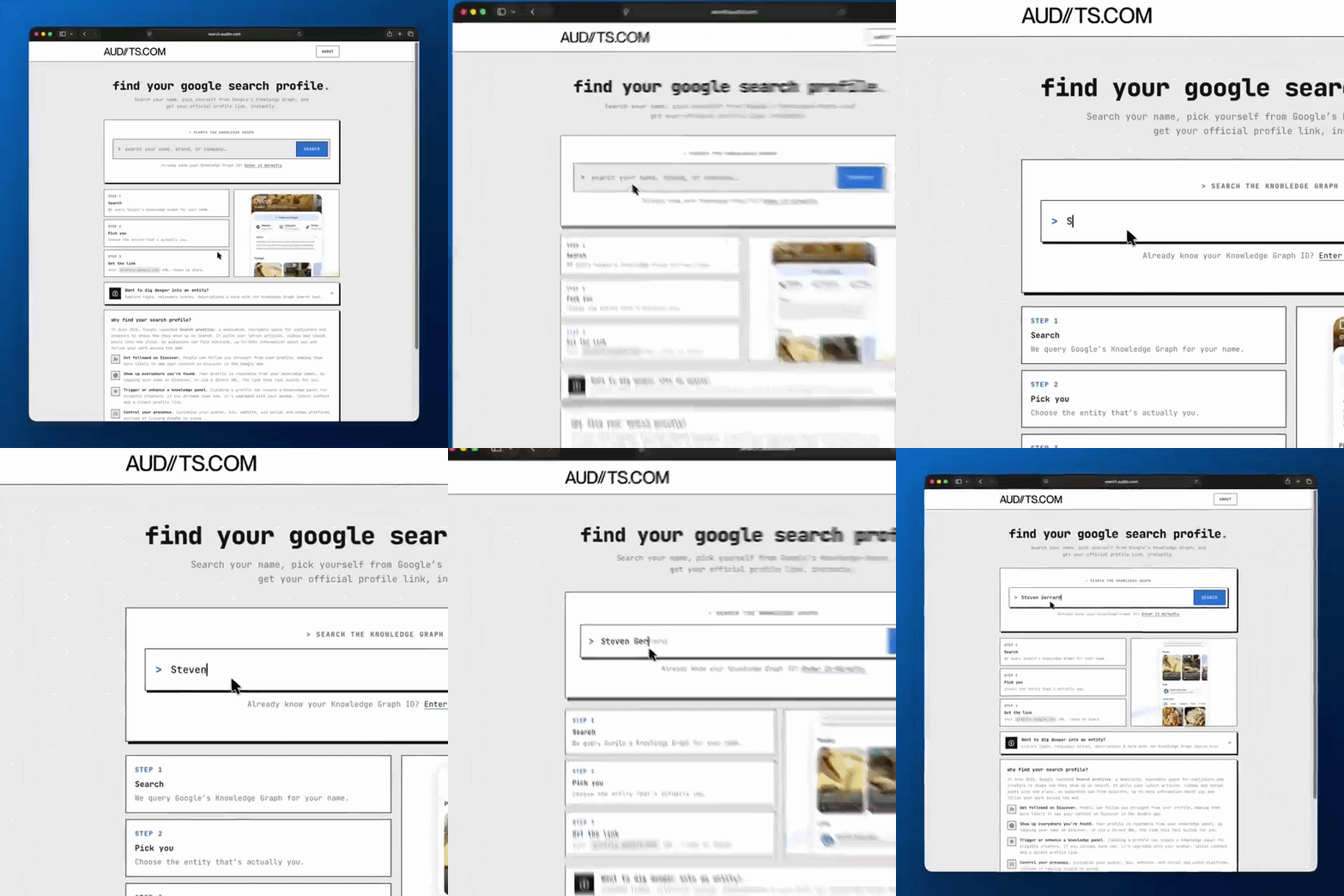
Finding Google's new Search Profiles
Google launched Search profiles for publishers and creators and Carl Hendy from Audits.com launched a free tool to help you find Search Profiles from anywhere.
Search Profiles provide eligible creators and publishers with a dedicated, shareable hub to showcase their work across multiple platforms including articles, videos, and social media posts.
Not only do these profiles help audiences find accurate, up-to-date information about you directly in Search, but they also introduce a powerful new discovery feature: users can now easily follow sources straight from their profile. Doing so makes your content much more likely to surface in their Google Discover feed on the Google app home screen.
Audiences can access these profiles in three distinct ways:
- Knowledge Panels: Claiming your profile might actually trigger the creation of a Knowledge Panel if you don’t already have one. If you do, it will be automatically enhanced with your updated avatar, latest content, and a direct profile link.
- Google Discover: Users can simply tap the name of a publisher or creator directly within their Discover feed.
Link to tool in comments [click “recent” and scroll if LinkedIn is being silly]
- Direct URLs: A shareable link that creators can distribute anywhere.
Who is Eligible? Initially launching in the U.S., the feature is currently open to publishers and creators who have a “sizable following” on at least one major video or social media platform. Once claimed, you can fully customize your hub with an avatar, bio, website link, and connected social/video channels. Google plans to expand this globally in the future.
|
Whitehats don't have to wait
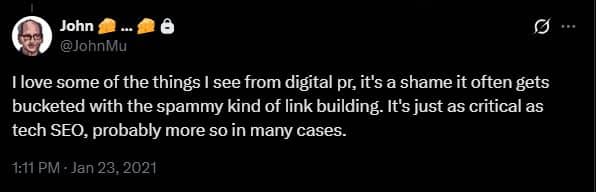
“With whitehat SEO, you have to wait for links” 🤦 No, honey, even Google says digital PR can be more important than tech SEO ☝
I commonly see two ‘arguments’ about whitehat SEO to do with links which are:
1) With whitehat you have to wait for links or 2) Digital PR links is the same as buying links
Both are not true.
1) Google has, multiple times, encouraged brands, SEOs, marketers, to engage in activities such as digital PR. You can see a screenshot from John Mueller saying in many cases, it is more important than technical SEO!
2) When someone says that paying someone to do digital PR is the same as buying a link, they are only exposing their lack of knowledge about what Google is trying to achieve with their link graph (or they are just trying to sell you links).
Links are used as a proxy of interest, popularity, and trust. It signals that this website trusts another to link to it, it signals that the content is related, of interest, and if it happens a lot, it signals popularity.
The reason link signals work is because there is an editorial decision - that is what Google is trying to capture by using link-based metrics.
If you pay directly for a link insertion, there is no more editorial decision, and therefore the link has no use (it is actually misleading) for what Google is trying to measure. This is why Google asks us to use tools like “nofollow” to mark sponsored links.
|
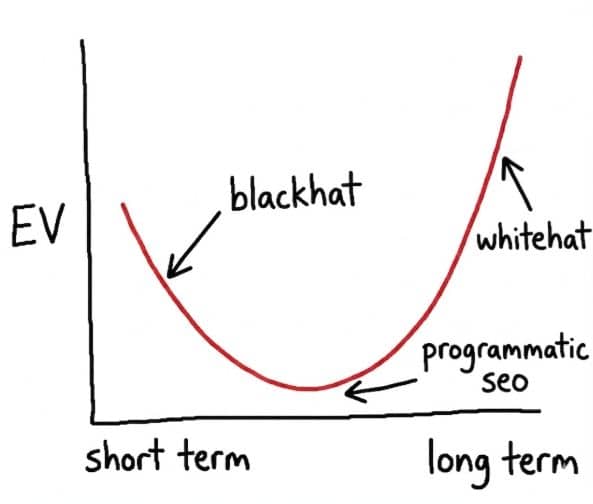
There is no grey hat
There is no such thing as 'grey hat SEO', and usually whatever people are considering 'grey hat' is the worst of black hat and white hat worlds, giving the lowest ROI 🚽
💰 You can make a lot of money very quickly with blackhat SEO, but you'll likely get banned; but you can rinse and repeat and make bank.
👮 If you're committed to one site/brand, then whitehat SEO gives excellent returns over a long time period with iterative gains over multiple updates.
🤡 The recent waves of 'scaled programmatic seo' are the latest example of people touting 'grey hat' as strategic direction. Google's guidelines are both specific ("don't buy links"), and vague "do things to manipulate" at the same time for a reason. Yes, you're not usually doing something so egregious it will get you banned in 12 weeks - but you are going to get caught, and the mediocre returns you make in the meantime (and the long recovery) means it is almost always one of the worst ROI strategies.
Most sites that "scale content programmatically" get a boon for 12 months or so before things come crashing down. We saw this with hundreds of sites in January, where programmatic content was slapped, and the whole site seemed to suffer with suppressed rankings because of it.
If you want to try and cheat, be a black hat, drive a tank through the wall and take everything. If you want to be around a long time, play by the rules. Don't be the greyhat that gets busted for stealing chewing gum.
It's either against Google's guidelines or it isn't. Don't call me a sith.
EV in the graph below is "Expected Value" (a bit like ROI).
|
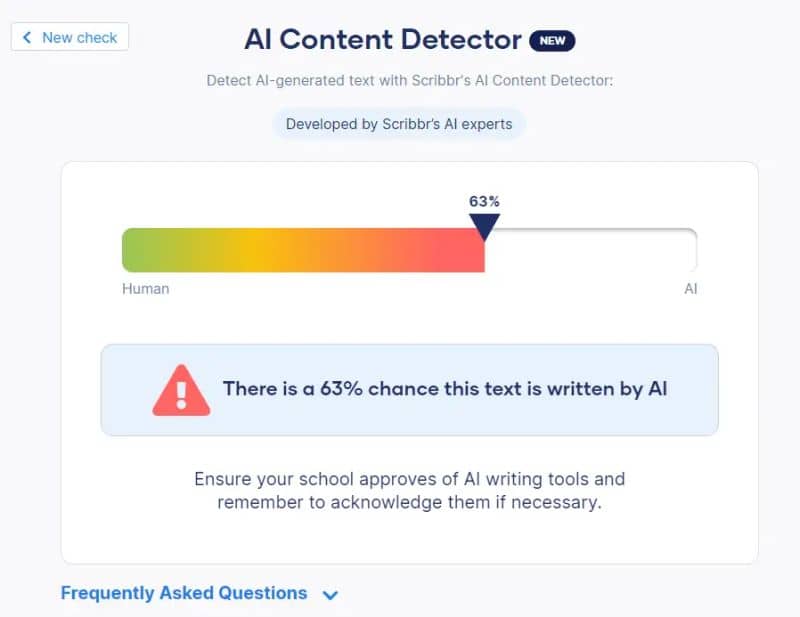
50% AI content doesn't mean 50% of the content is AI
Most people completely misunderstand the results that AI content detectors give them, and it's painful to see 🫣
"The AI detector said my content was 50% AI!! 😡 😡 😡"
Almost all AI detectors that give a percentage score are not telling you "this percentage of the content is AI." They are telling you "I am this percentage sure it is AI."
This means, for instance:
20% AI = It is telling you that your content probably isn't AI! I see so many people getting mad at <50% scores, but it is actually affirming that your content is likely human.
50% AI = The detector doesn't know! It is a coin flip. You could guess and be just as accurate.
80% AI = Likely, but this still isn't a guarantee. It is saying it will be wrong 1 in 5 times, so even at 80%, it is only an indicator.
99% AI = Now you are in territory where it is very likely AI content. These systems are not perfect, e.g., tools like Grammarly can push you in this direction, but it is worth investigating at this point.
|
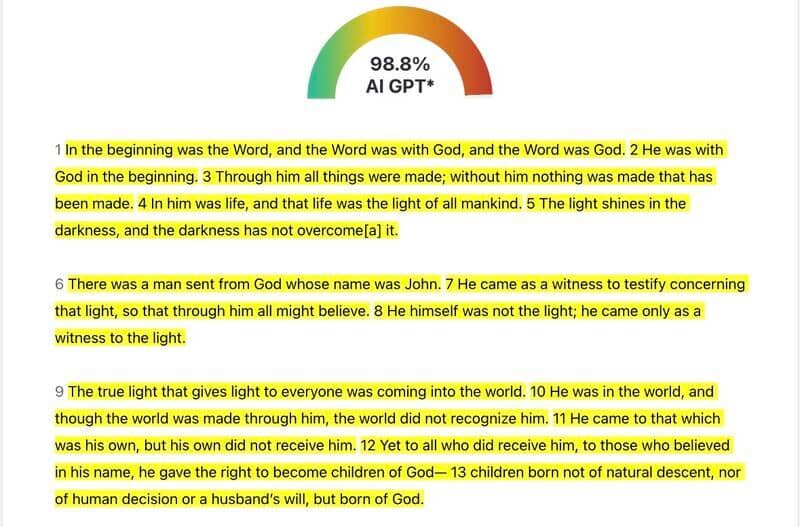
A biblical misunderstanding of AI detection
I am tired of seeing this posted as evidence that "AI detectors don't work", so I will try and give a non-click/rage bait explanation of why that take is wrong ⬇️
🔤 LLMs work by predicting the next most likely "token" (a set of characters), based on the previous ones, which comes from a very large set of probabilities.
📖 These probabilities are derived from training data, which is an unimaginably vast load of text from books, the web, and wherever big tech can nick it from.
📊 The interesting thing in token prediction is there is a very sharp bell curve of "what probably comes next" in terms of probability (which is why we get coherent text). So for "I want to book a [blank]", it is far more likely [blank] is "room" than say, "velociraptor", unfortunately.
🔀 Sometimes the 'wrong' token gets picked, and sets us off producing misinformation, otherwise known as 'hallucinations', but the fact remains, those probability relationships still exist.
🔍 AI detectors map these probabilities to each model to understand how they generate content. Their job is essentially: "does the provided text match a very similar probability distribution to the training data?" Which is a fair way to do detection.
✝️ Something like the Bible is some of the most common text on the web. It is in the training data over and over, so when you provide it verbatim, you are essentially asking the tool "does this training data match the training data?" and it answers "pretty much!" - showing it is functioning correctly.
😕 Of course, it is not in the designed scope of the AI detector to detect content that was written pre-GenAI, because... that's silly! It cannot be written by GenAI if it came before GenAI.
⚠️ For any new content it can help, but it is worth knowing that tools like Grammarly will push you towards these probabilities and you may get false positives there too.
They're not meant to be perfect, but they are a helpful tool imo.
|
Refer subscribers and earn rewards!
|
|
|