|
SEO updates you need to know
Sponsor: Semrush

Meet the AI visibility leaders in retail, plus new tactics
AI search is reshaping customer journeys and how shoppers discover and choose products. But many retail marketers don't yet have a clear benchmark of AI visibility, who's winning and why.
Semrush's AI Visibility Index changes that. Our new study is built on a US prompt database of 126 million prompts, mapping exactly which retailers are dominating AI recommendations across ChatGPT, Google AI Mode, Gemini, and AI Overviews. As well as where the opportunities lie.
|
Search with Candour podcast

Is SXO the future of SEO?
Season 4: Episode 77
Laura Lancu joins Search with Candour to talk about the growing crossover between SEO and UX and how we should all thinking about 'Search Experience Optimisation' (SXO) instead of traditional SEO.
Lara explains how measuring behaviour with heatmaps and A/B tests can justify regular collaboration with design teams, why SEOs should avoid jargon and use show-and-tell examples (like mobile layout shifts), and how conversation cadence depends on shipping frequency and project importance.
|
|
|
Wait! Allow me to hijack you quickly…
If you like nuanced answers, follow my Substack.
If you're subscribing to Core Updates, you're probably like me, and like your information quickly, and in bite-sized chunks. However, sometimes this can lead to misunderstandings, and some topics deserve more exploration.
That's why I've started a Substack where I take deep-dives into these topics. Last week, I wrote about:
It would be great to have you along for the ride! Anyway, onto this week's tips.
|
This week's solicited tips:
SEO, the final frontier
First mover advantage in SEO is huge and often overlooked, you capture the majority of demand, you get cited, and ride that initial wave of links and interest ⤵️
The main blocker is that a lot of content is built only on 'keyword research' (or asking an LLM), and by definition, you're only looking into the past, never the future.
The best thing you can do is use this data as a starting point to have an actual conversation with the relevant person/expert. If you email them, 99% of the time you'll get answers to your questions verbatim. If you have an actual conversation with them, it naturally flows and ebbs into things they know that aren't surfaced in that data yet.
There are boatloads of AI tools that can help you record and transcribe content to speed this process up, but I can't over-emphasise how valuable this is in terms of 'non-commodity' content and EEAT.
|
These are the pitches for digital PR
So many digital PR attempts fall flat because organisations are not prepared. Candour's Fran Johnson has done a *fantastic* job putting together this guide on the things you need do (show her some appreciation!):
1️⃣ Understand what you're getting Digital PR isn't just one single tactic; it's a mix of strategies, including:
– Creative campaigns
– Pitching expert insights
– Reactive newsrooms
– Product promotion
– Brand PR
2️⃣ Define your capabilities and prepare your team Make sure you have a solid foundation before you start reaching out. You need to clearly outline:
– Your brand proposition, goals, and mission
– Your brand's style and tone
– Your internal resources and external budget
3️⃣ Start with research and planning Never skip the strategy phase! Make sure your approach is aligned with:
– Your commercial and SEO objectives
– Your audience's needs
– Publisher gaps and preferences
– Top industry tactics
|
Our mission is to explore strange new traffic
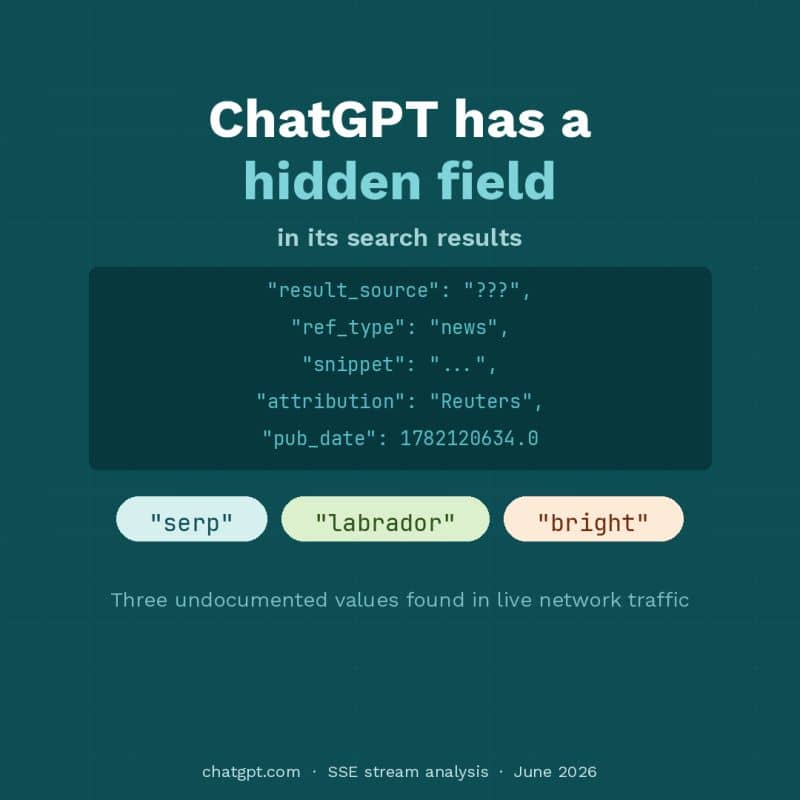
I've been analysing the raw network traffic that flows when ChatGPT searches the web, and found something interesting buried in the response data. ⤵️
I saw Metehan Yeşilyurt teasing with this data, so I wanted to publish the few scraps I've had time to put together on this before he steals my thunder with something amazing 😭 (feel free to add to the below, my sample sizes are tiny and I imagine Peec AI probably has a few floppy disks worth).
Every search result ChatGPT retrieves contains a hidden field called 'result_source'. It's never shown to users and isn't documented anywhere. It seem to be able to take one of three values:
📜 "serp": The open web baseline. Standard real-time results from official sites, aggregators and social platforms. Shorter snippets, pub_date often null.
🐕 "labrador": licensed quality content. This one surprised me. It covers premium news wires (Reuters, The Guardian), Wikipedia, AND product review sites like RunnersWorld. It's not just a news feed, it's a structured quality gate. Snippets here can run to over 1,000 characters, essentially full article extracts.
🛠️ "bright": The publisher mix points strongly to Brightdata structured web datasets under the hood, which are ready-to-use, structured business intelligence datasets pulled from thousands of web pages powered by Bright Data’s Deep Lookup AI technology (Metehan suggests this could be a test).
💡 There's also a companion field called 'turn_use_case' that classifies your query before any search happens, and that classification determines which pipelines fire:
→ "instant search" (news, sports, etc): all three pipelines run in parallel
→ "shopping": labrador only, zero serp or bright (v small sample size)
→ "text" (how-to, instructional): no web search at all, answered from training data
This matters for anyone thinking about GEO/AEO strategy right now. The question isn't just 'is my content good enough to be cited?', it's 'does my content type even reach the pipeline that fires for my query intent?'.
Do you like this kind of research? Well, great news. I'm speaking at brightonSEO in October after Kelvin Newman was on the hunt for 'someone has clearly spent far too long thinking about one specific technical SEO problem'. 🤓
My talk is called 'Wiretapping the SERP: Capturing Network Data to Reverse Engineer Google' and covers all these kinds of shenanigans.
|
To seek out new content and new metrics
Trying to settle 'is this non-commodity content' discussions internally can be challenging, but a good way to solve it is with (gasp) data. 🤯
You can easily set up the most basic metrics to see what users think because you're always going to be biased about things you've had a hand in creating, so take a data-led approach:
I've seen lots of abstract ways people have used to try and infer if content is good; bounce rate, time on page, engagement rates, but....
Have you just tried asking them?😲
For instance, if you're producing informational content, a simple:
'Was this article helpful? 👍👎' button at the bottom of every page.
Then link this up to your Google Analytics.
While you'll also have some bias (people more often respond negatively than positively), this will apply across the board, so you have an adequate base for comparison.
If you need to work on improving your content, you've got a great data point to start work on outliers that are downvoted, so you can ask:
– Why is this content not meeting user expectations?
– Are we missing some key information? (You checked AlsoAsked – right?)
– Is the current information displayed badly?
– Did they just not like what was served?
You can of course, do more qualitative assessments from there, but there is literally no downside to collecting this data upfront.
|
To boldly code, where no one has coded before
I've seen tiny bits of invalid code break the HTML which has knock-on effects causing ranking issues:
Sometimes Google isn't great at deciding which page is the canonical, so you can give it some hints with the canonical tag, howeverrrrr:
- Canonical tags must be declared in the otherwise they will be ignored. (This is bad).
- Putting invalid HTML elements in the will break it for search engines, which will likely ignore anything after them – such as canonical tags.
To quote Google's documentation: 'We strongly recommend that you don't use these invalid elements in the , but if you must, place these invalid elements after the ones you want Google to see. Once Google detects one of these invalid elements, it assumes the end of the and stops reading any further elements in the .'
|
Refer subscribers and earn rewards!
|
|
|